Drylands may not be the first ecosystems to come to mind in terms of relevance for the global carbon cycle, but research has shown that they are very important, particularly for explaining the year-to-year differences in the land carbon sink but also for long-term changes (Ahlström et al., 2015).
Many of these insights are based on outputs from land surface models (LSMs) that simulate changes in vegetation and soil based on drivers such as CO2 concentration, climate and land-use change. While very complex, these models still have to make many simplifying assumptions in their representation of reality, mainly to reduce computational requirements. It has been argued that this leads to drylands not being represented adequately in LSMs with implications for the accuracy of dryland carbon cycle simulations (MacBean et al., 2021).
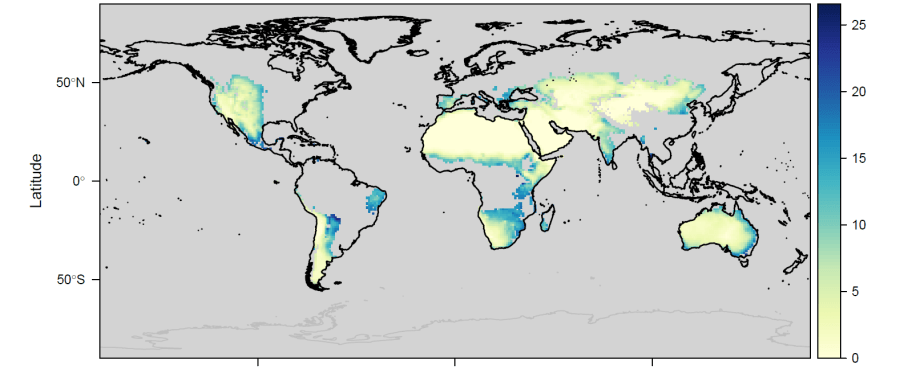
In this work, which was a close collaboration with dryland expert Andy Cunliffe, we set out to investigate some of the important LSM outputs for drylands by using satellite data based estimates as a comparison. We looked at gross primary productivity (GPP, amount of carbon captured by photosynthesis in a given period of time) and vegetation aboveground carbon stocks (AGC) (Fig. 1) as simulated by 12 state of the art LSMs and their spatial and temporal agreement with satellite estimates.
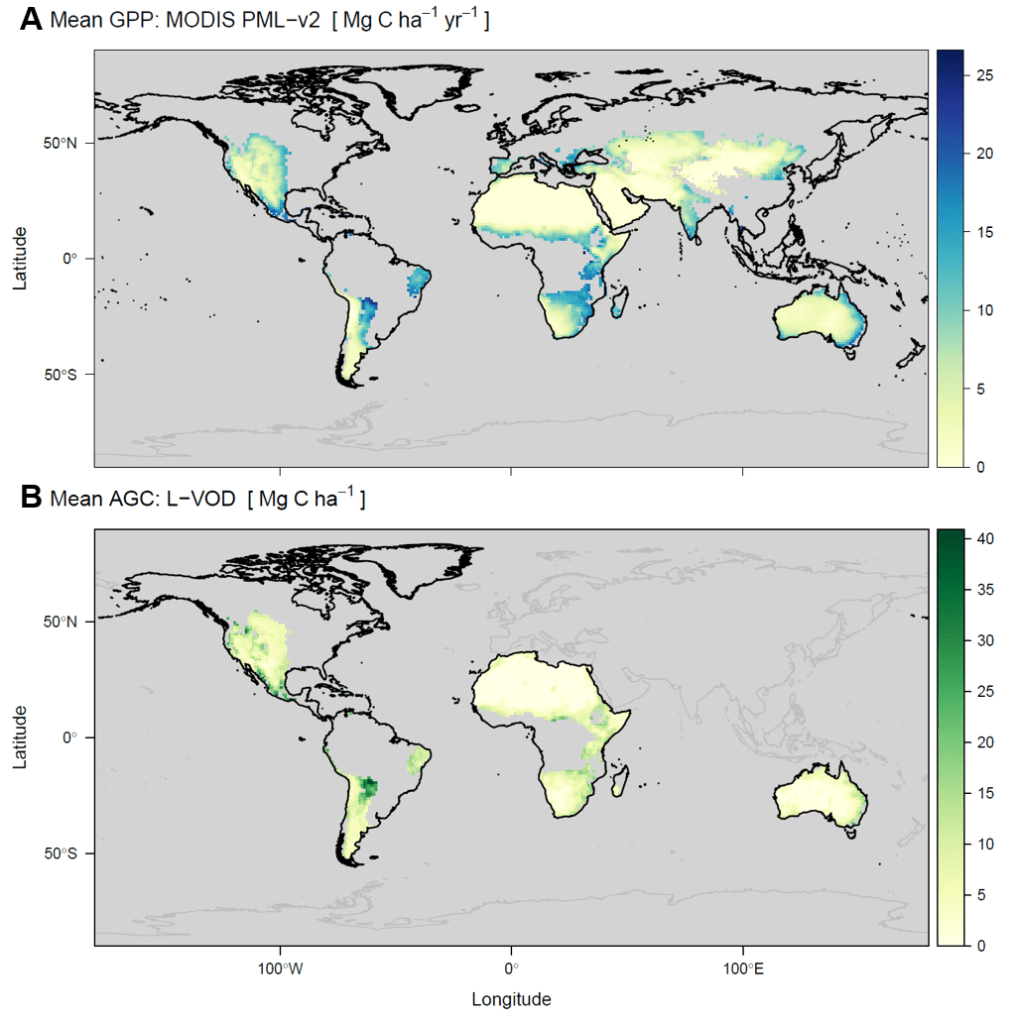
We found that there was low agreement between LSMs and with satellite derived values for aboveground carbon in drylands, while spatial and temporal agreement for GPP was better, particularly in terms of variability between years (Fig. 1).
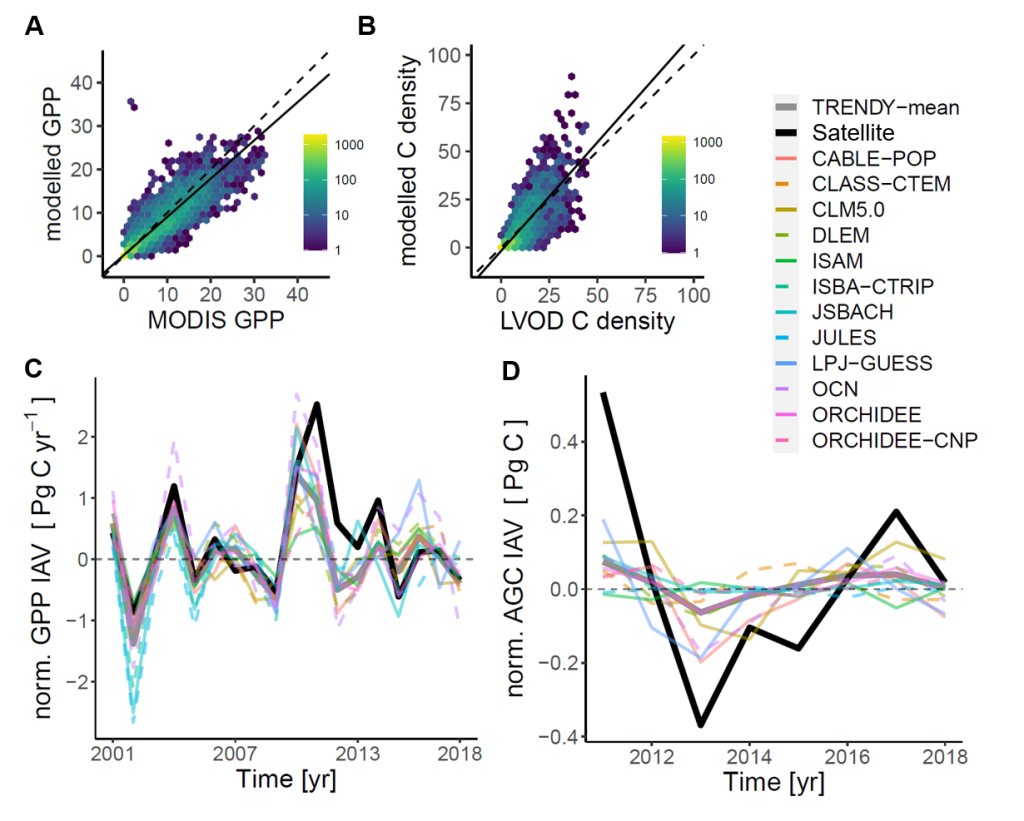
There are some uncertainties in this analysis which should be noted, for one we are comparing outputs from models run at very different spatial resolutions and the satellite reference data don’t necessarily represent the truth because there are other models involved in deriving estimates from the satellite observations.
Still, where LSMs show greater agreement with each other and the mostly independent satellite data we can be more confident that processes are well represented in the models and vice versa. We can therefore conclude that while broadly GPP appears to be captured reasonably well (though not necessarily locally as shown by MacBean et al., 2021), the processes of carbon release in drylands, e.g. due to fire, are not sufficiently well represented across LSMs and these simulations should be interpreted with caution in dryland environments.
 DF Remote Sensing